
The short answer: 105 is a real, usable score that clears the entry bar at a specific tier of universities, and it is below what the typical program asks. Our database holds 481 program records that publish a Duolingo English Test minimum. A 105 meets or beats the stated minimum in 117 of them, about one in four. Whether that makes 105 good depends entirely on which quarter of the list your target universities sit in.
Key takeaways
117 of 481 program records set their Duolingo minimum at 105 or below. The most common single minimum is 120 (115 records), and the middle of the distribution sits around 115. On conversion tables, 105 corresponds to about IELTS 6.0 and TOEFL iBT 70 to 75. And there is a twist: several universities that ask IELTS 6.5 set their Duolingo bar at exactly 105, which makes the Duolingo route the easier door into the same program.
What the minimums actually look like
| Duolingo minimum in the record | Program records |
|---|---|
| 80 to 100 | 62 |
| 105 | 55 |
| 110 | 92 |
| 115 | 65 |
| 120 | 115 |
| 125 and above | 92 |
Read against that table, 105 is a lower-middle score: comfortably above the entry tier, clearly below the competitive tier. Programs that accept it include Arizona State University's general graduate admission, undergraduate and graduate admission at the University of Texas at Dallas, and undergraduate admission at the University of Kentucky and the University at Buffalo. By degree level, the records a 105 clears split into 73 bachelor's, 37 master's, and 7 PhD entries, so it reaches furthest at undergraduate level.
The conversion, stated carefully
Conversion tables put a Duolingo 105 at roughly IELTS 6.0 and TOEFL iBT 70 to 75. Treat any table that calls 105 an IELTS 6.5 equivalent with suspicion; 6.5 territory starts around 120 to 125. But here is the part the tables miss: universities do not convert mechanically. Arizona State and UT Dallas both pair an IELTS minimum of 6.5 with a Duolingo minimum of 105 in their own records. If your IELTS is stuck at 6.0, the same university may still take you through the Duolingo door. That is a property of each university's policy, not of the conversion chart, and it is worth checking program by program in the database search.
What 105 does not unlock
364 of the 481 records ask for more than 105, and the single largest group asks 120. If your list is built from highly ranked research universities, 105 is a starting score, not a finishing one. The gap from 105 to 120 is also the most trainable stretch of the Duolingo scale, because it is mostly subscore balance: the integrated subscores reward even performance across literacy, comprehension, conversation, and production.
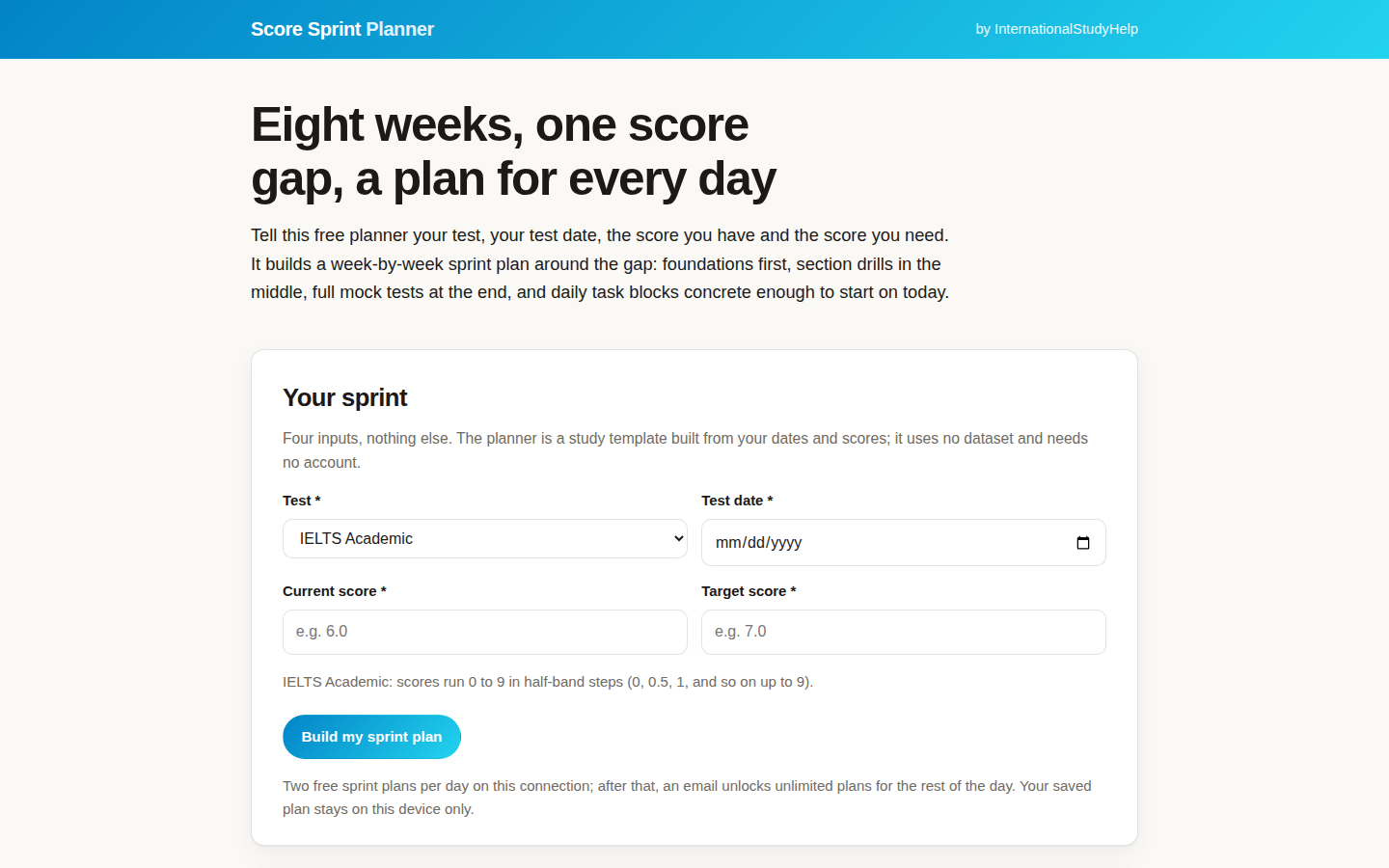
How to move from 105
First, find out how much you actually need to improve: check your target programs' stated minimums before you study anything. Second, work the weakest subscore rather than the whole test; an uneven profile is the usual reason a 105 stalls. Third, practice daily in short sessions and retest on a schedule instead of cramming. The Score Sprint Planner builds that schedule from your current score, your target, and your test date. For the wider map of which universities take the test at all, see our earlier count of what a 105 unlocks, university by university.