
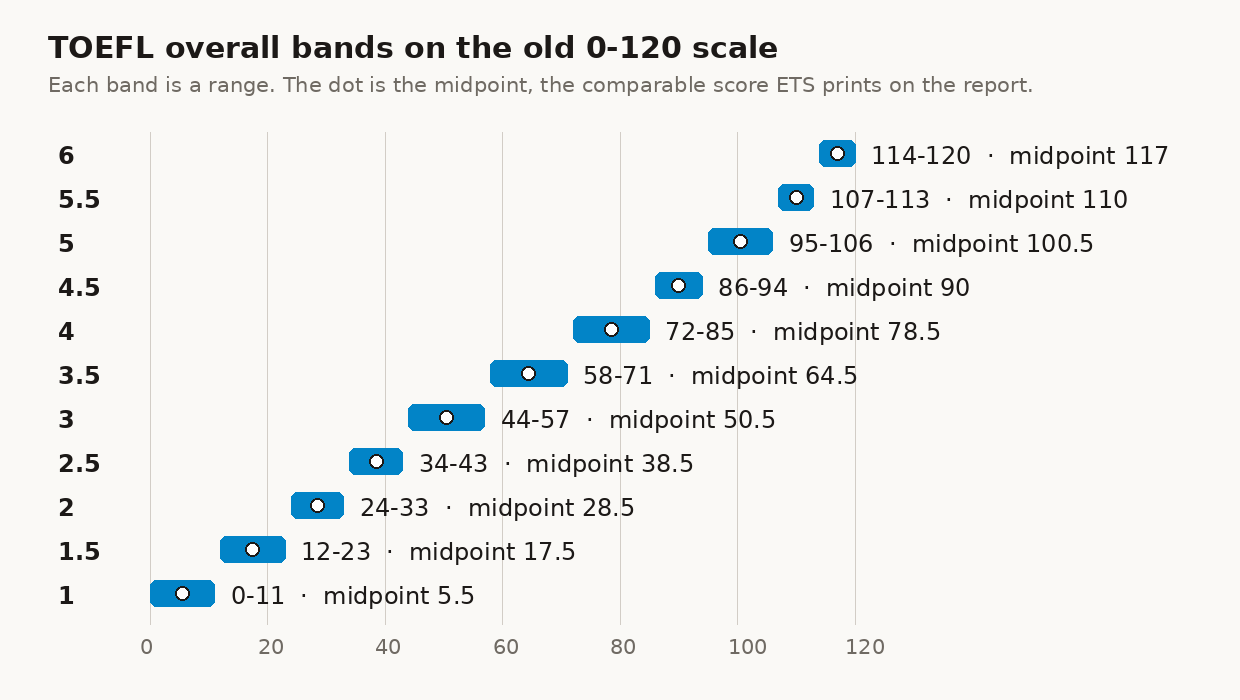
If you took the TOEFL this year, your score report leads with a number most university websites never mention: an overall band between 1 and 6. Beneath it sits the familiar score out of 120, and that second number is where the trouble starts. ETS defines the 0-120 figure on a new report as the midpoint of a range, not the bottom of one, and Fall 2027 is the first full application cycle that has to live with both scales at once. Read the midpoint as a floor and you will aim at the wrong target, in one direction or the other.
1. What changed on January 21, 2026
The change is not breaking news this week, and it is worth saying so plainly: it took effect on January 21, 2026. Since that date, TOEFL iBT reports show four section scores and one overall score on a 1 to 6 scale, in half-point steps. ETS aligned the bands to the CEFR, the framework behind most school English levels, and the overall score is the average of the four sections, rounded to the nearest half band.
For a two-year transition, through January 2028, each report also carries a comparable overall score on the old 0-120 scale. Here is the sentence everything else hangs on, from ETS's own scores page: that comparable score represents "the midpoint of the corresponding total range." ETS says in the same place that institutions "are updating at different times, and some may still list requirements using the 0 to 120 format." Both halves of that are now visible in the wild, in the Fall 2027 cycle.
2. Every band is a range: the ETS table
This is the overall table ETS publishes. ETS prints each band's total as a floor, 86+ meaning 86 and up. The full range is what the next band's floor implies, and the last column is the midpoint of that range, the comparable score a report carries.
| Overall band | ETS total (0-120) | Full range | Midpoint: the comparable score |
|---|---|---|---|
| 6 | 114+ | 114-120 | 117 |
| 5.5 | 107+ | 107-113 | 110 |
| 5 | 95+ | 95-106 | 100.5 |
| 4.5 | 86+ | 86-94 | 90 |
| 4 | 72+ | 72-85 | 78.5 |
| 3.5 | 58+ | 58-71 | 64.5 |
| 3 | 44+ | 44-57 | 50.5 |
| 2.5 | 34+ | 34-43 | 38.5 |
| 2 | 24+ | 24-33 | 28.5 |
| 1.5 | 12+ | 12-23 | 17.5 |
| 1 | 0+ | 0-11 | 5.5 |
So the question students keep typing, what is TOEFL 4.5 in 0-120, has a two-part answer: the range 86 to 94, and the single comparable number 90, its middle. No band is a point. The narrowest bands span 7 points and the widest span 14, which is exactly why a one-number conversion cannot be honest. ETS publishes the same kind of ranges for the four sections against the old 0 to 30 scales; the trap in the next section works there too.
3. The midpoint trap, in both directions
Direction one: reading the comparable as the floor. A student holding a 4.5 sees the comparable 90 on the report and treats 90 as what a 4.5 is worth. A target program still lists a legacy minimum of 92, so the midpoint math says 4.5 falls short and only a 5.0 clears it. But 92 sits inside the 4.5 range, near the top of it, and the next section shows a university pairing its old 92 with the 4.5 band itself. Aiming a full band too high means weeks of extra prep against the wrong number.
Direction two: reading the comparable as the band's whole value. Take the old graduate staple, a minimum of 80. The band whose range contains 80 is 4.0, spanning 72 to 85. Its midpoint, though, is 78.5, below the 80 line. A student who retakes the test and earns a clean 4.0, then checks the comparable figure against a page that still says 80, can walk away thinking a matching score fell short. It did not. The band is the score now; the comparable is a translation aid, and like every translation aid it has a bias: it understates the top of each band and overstates the bottom.
4. One university, two minimums
The University of Washington's MPH in Epidemiology, now taking applications for Fall 2027 entry, shows what an updated page looks like. Its requirements state the minimum as "4.0 (or 80 for tests taken before January 21, 2026)", and the score "required to avoid required English courses" as 4.5, "or 92 for tests taken before January 21, 2026". Hold those pairings against the table: Washington kept its old numbers, 80 and 92, and attached the bands whose ranges contain them. It did not attach the midpoints, 78.5 and 90, because the midpoints were never the requirement.
Now look one level down at the same university. Washington's postbaccalaureate admissions page sets its minimum at 4.0 for tests taken on or after January 21, 2026, and at 76 for tests taken before it. One band, 4.0, two different legacy partners, 76 and 80, inside a single institution. There is no universal conversion table an applicant can carry from school to school. Each institution chose its pairing when it rewrote its page, and many pages have not been rewritten yet.
5. What this means for the numbers on this site
Our own house, honestly: the database behind this site holds 1,214 program records, and every TOEFL minimum in it is stored as a 0-120 number. There is no 1 to 6 field, because the records were built from requirements pages written in the old format, and most of those pages still read that way today. Our Score Sprint Planner asks for your current and target TOEFL scores on the 0-120 scale for the same reason. So until listings catch up, every TOEFL figure you find here needs the translation in the table above: find the band whose range contains the listed number, and treat that band as the real target. The program search still answers the question it always answered, which programs list a cutoff near yours; this article is how you read that cutoff in 2026.
6. How to read a requirement now
Four habits cover nearly every page you will meet this cycle:
- If the page lists a band, you are done converting. Your report leads with bands, and the band is what the institution checks.
- If the page lists only a 0-120 number, find the band whose range contains it. A listed 90 is a requirement inside the 4.5 range, not a demand for a comparable of exactly 90.
- If the page lists both, trust the institution's own pairing, even when it is not the midpoint. Washington's 4.5 beside its 92 is the requirement; your conversion is not.
- If the page is ambiguous, ask the institution. ETS closes its scores page with the same advice, because the institution's reading of your report is the one that counts.
Once the target band is real, the prep question gets simpler. Our TOEFL requirements comparison shows how the common graduate cutoffs cluster, and the IELTS vs TOEFL guide is worth reading before you lock in a test. Then turn the gap into a schedule: the 8-Week Score Sprint Planner builds a week-by-week plan from your current score, your target and your test date. Two new plans a day are free on your connection; after that, an email unlocks unlimited plans for the day. Plan against the band, not against a midpoint.